A Short History of Short Attacks, Part One
posted by The Traveller on Saturday, May 28, 2011

It all started with John Bird a.k.a. Waldo Mushman, one of the most vocal figures in the growing circle of short sellers targeting Chinese stocks. In early August of 2009 Bird proclaimed the TCM (Traditional Chinese Medicines) company China Sky One Medical (CSKI) a fraud: "Based on the massively inflated and inconsistent numbers, I have come to believe that China Sky One Medical is actively committing fraud." Over the next 12 months, Bird reiterated his call numerous times, on any platform or message board he found his way to.

The company responded with press releases and denied all allegations. In one of those attempts (July 23, 2010) "the management of China Sky One Medical reminded investors that Waldo Mushman was misleading investors by counterfeiting SAIC documents and posting them on its website and other blogs." It did not help them. The stock lost 81.63% of its value since John Bird's initial call, so we can safely assume that he made a good chunk of money with his short position.

Bird got help from other short sellers. On February 21, 2010, Manuel Asensio accused CSKI on Seeking Alpha of not disclosing material information: "The Chinese government order to stop selling eight of CSKI's products seems to be material to CSKI's operating condition, yet CSKI has provided no disclosure of the order to U.S. investors." In a similar vein, The Financial Investigator blogged on August 4, 2010, that "China Sky One did not disclose the receipt of its own subpoena in its filings nor did it reference that its auditors had received one." At that time the Securities and Exchange Commission had issued subpoenas to China Sky One Medical and its auditors, MSPC. And roughly one month later, The Street Sweeper published on its website that "MSPC is a past target of securities regulators that has since come under fire for allegedly approving flawed financial reports issued by CSKI itself."

China Sky One is still trading on Nasdaq at the time of writing. Yet the stock price is in a constant decline. From $22.75 at the end of 2009, the stock closed at $6.97 one year later, and now you can buy it for just $2.83. At Friday's close, CSKI is down 59.40% for the year.

The next target on our list of short attacks is L&L Energy (LLEN), a U.S.-based coal mining company with the majority of its operations in China. On January 11, 2010, The Street Sweeper portrayed LLEN as a "relatively new Chinese coal miner accused of misleading investors in the past, [that] has managed to become a stock-market winner by posting some of the most incredible numbers recorded in the entire industry."

The stock kept rising into summer until Herb Greenberg used his platform on CNBC to repeatedly attack the company and its Chief Executive Officer: "CEO and founder Dickson Lee was fined $65,000 by FINRA and banned from the securities industry for a year." Greenberg's attacks on live television sent the stock lower. From $11.05 at the time of the first broadcast (December 21, 2010), LLEN dropped 44.53% to close at $6.13 last Friday. The stock is down 43.25% for the year, but it has recovered some from its all-time lows, printed in early April at $4.29.

On January 26, 2010, a short-selling outfit named "Worthless Pennies" called out pharmaceutical company China Biologic Products (CBPO). "The urgent warning we have for investors today is that the background check and evidence we collected clearly prove direct ties between CBPO management/directors and convicted criminals who exercise control of the company, a criminal background of the CEO of its operating subsidiary and a history of laundering money stolen from investors, none of which the company disclosed in its filings." That call was initially very successful and sent CBPO 25.94% lower on the day of its release.

China Biologic reacted three weeks later by announcing a thorough internal investigation and stating that "the Company believes that this is an attempt to discredit the Company's management and disrupt the Company's business and operations." In December 2010 the company informed investors that "the Special Committee of its Board of Directors has completed its investigation of several allegations that appeared on certain financial websites in January 2010." CBPO's strategy was highly successful as the stock has more than doubled since the Special Committee was formed on February 17, 2010. It moved from $7.62 to $16.10 for a gain of 111.28%, and CBPO is one of the very few Chinese reverse mergers the market has not punished yet - the stock has gained 33.27% since the beginning of 2010, while most of its RTO peers have been thrown into the stock dumpster. The "Worthless Pennies" outfit seems to have closed its doors, and its website does no longer exist.

Citron Research's first target in the China small caps universe was newly uplisted SinoCoking Coal and Coke Chemical Industries (SCOK) on March 11, 2010. Citron called it "an ugly duckling Chinese coal deal with an utterly improbably rise and ridiculously unsustainable run-up." The stock was subsequently destroyed, dropping from $34.09 at the time of Citron's report to $5.93 last Friday, a loss of 82.61%.

Another attack on SCOK was launched by Sharesleuth on September 13, 2010. The author, Chris Carey, wrote "that no fewer than eight people who participated in [SinoCoking's share] placement have been the subject of Securities and Exchange Commission actions or criminal prosecutions." The stock is down 50.46% year-to-date and fails the Trading China Safety/Risk Model with an "Extreme Risk" score.

Lihua International (LIWA), a company that sells wire produced from refined scrap copper, was repeatedly a short seller target. On May 9, 2010, Seeking Alpha published a Steven R. Chapski article stating that "in order for the SEC financial statements to be correct, LIWA paid the Chinese government $4 million for income taxes in 2009, yet reported $0 in profit tax to the same Chinese government on their SAIC financial reports." The company responded two weeks later by providing its most recent SAIC documents on its website and "proving" that these results were consistent with those reported in the company's SEC filings.

Chapski didn't back off, though. In December he posted another article, insisting that in his belief "the SEC financial statements continue to be wrong." None of those reports had any permanent effect on LIWA's stock price. The stock closed 2010 with a 7.5% gain, and has only recently come under pressure, consistent with its Chinese reverse merger peers. For the year of 2011, LIWA is now down 33.9%, and the stock's short ratio has spiked to 25.65% of the float.

To be continued...

Labels: , , , , ,

China Watchlist for the Next 4 Weeks
posted by The Traveller on Monday, February 21, 2011

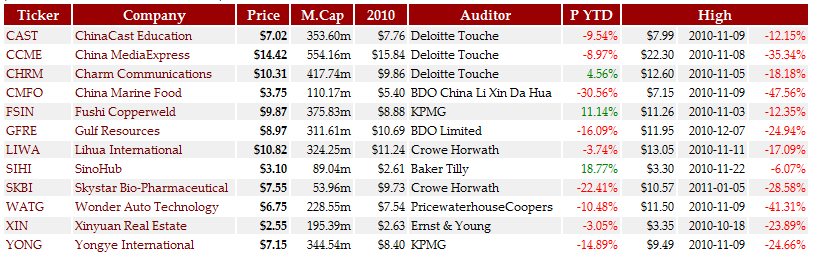
Lihua International (LIWA) is currently trading at $10.82, down 3.74% for the year and down 17.09% from its November 11 high at $13.05. The Trading China Tracker Score is 9 (Buy).

LIWA is currently trading at about 6x earnings for 2011 on a fully diluted basis. The company has a $15 million share repurchase program in place, a Top 10 auditor with a strong China team (Crowe Horwath), and additionally Deloitte has been contracted to do an internal control implementation and review. The stock has come under pressure from short sellers last year, and management responded with posting their Chinese SAIC filings on its website. Rodman & Renshaw confirmed the authenticity of those filings for both subsidiaries - Lihua Electron and Lihua Copper - and concluded that there are no inconsistencies between Lihua's SEC and SAIC filings. Rodman has a $20 target on the stock, and Global Hunter calls it "the single best pick in the US-listed China space."

We are waiting for the 10-K filing in early March, and possible FY 2011 guidance which we expect to come in around $1.85 earnings per share. LIWA's short interest is among the highest in the sector, having reached over 27% of the float by the end of January. We wouldn't be surprised to see another attempt to attack the stock before the annual report is filed, which we would use to start building a position.

ChinaCast Education (CAST) is currently trading at $7.02, down 9.54% for the year and down 12.15% from its November 9 high at $7.99. The Trading China Tracker Score is 5 (Hold).

ChinaCast is in the post-secondary education (universities) and e-learning business in China. Nothing much happened to CAST's stock price in the last two years. The stock closed in the $7-8 range both 2009 and 2010 and is now still trading at this level. But the company looks rock-solid and I wouldn't be surprised to see the stock finally breaking out to the low double digits this year.

We asked the company for a comment on the ongoing credibility crisis in the US-listed China sector:
Trading China: Can you reassure investors that your company is not a possible target for the SEC investigation?

ChinaCast: When ChinaCast was originally formed and did a Series A investment with Intel Capital and Hughes back in 2000, our US investors mandated that we use a Big 4 auditor (in this case, Deloitte Touche-DT) from day one and we've been using DT now for over 10 years. We actually went public via a traditional IPO on the Singapore Stock Exchange back in May 2004, which believe me is a much more vetted process than the reverse merger and in some cases IPO process to get listed on US exchanges. While we did do a reverse merger to move our listing from Singapore to the US, it was through a public tender offer process that was highly scrutinized by the Singapore Stock exchange regulators, the SEC, Deloitte, as well as the shareholders of both companies.

We are now a Delaware listed company (fully audited 10K reporting) and have been Sarbanes-Oxley 404 compliant for the past 3 years. I'm not sure how many other PRC companies listed in the USA file fully audited form 10K, have a Big 4 firm as their auditor for the past 10 years and are SOX 404 compliant but probably less than 10%. Our management team have a long, successful history of working in global multinational companies and have run other publicly listed companies and we have a very experienced, shareholder friendly board of directors.

In addition, the senior management team and board have purchased approximately $9.5M worth of common stock during the past year. We believe that is a clear differentiator and if any regulatory body were evaluating targets we believe this would send a clear message on where management stands in its conviction of the business and the numbers. With that being said, we also strongly welcome the opportunity to host investors and analysts to our corporate facilities, network operations centers and universities in China to meet our executives and to conduct due diligence at our facilities. (Michael J. Santos, President-International, ChinaCast Education Corporation)
We are adding CAST to the Trading China Model Portfolio today.

Watchlist for the Next Four Weeks:


Model Portfolio Changes:

Lotus Pharmaceuticals (LTUS.OB) is currently trading at $1.84, down 28.96% for the year and down 38.26% from its November 10 high at $2.98. The Trading China Tracker Score is 14 (Strong Buy).

We are closing our position here for a loss of 1.08% or $52. The ongoing discussion about the expensive land purchase in Inner Mongolia will likely hang over the stock until the land is actually sold. We believe LTUS will continue to trade on depressed multiples for the coming months.

Trina Solar (TSL) is currently trading at $29.41, up 25.57% for the year and down 7.78% from its October 14 high at $31.89. The Trading China Tracker Score is 8 (Buy).

Trina Solar is set to report earnings this Tuesday. While we expect another beat and raise quarter, we also believe that the focus will shift to H2/2011 where solar bears will argue big oversupply pressure will be looming. Most solar stocks had a stellar year so far and a pullback is likely, especially after market leader First Solar (FSLR) will report on Thursday. First Solar's stock is massively overvalued compared to its Chinese peers and an expected sharp drop after the Thursday report won't leave the Chinese names unaffected. We are closing our position for a gain of 24.04% or $1,197.00.

JinkoSolar (JKS) is currently trading at $29.67, up 47.46% for the year and down 28.94% from its November 4 high at $41.75. The Trading China Tracker Score is 11 (Buy).

The second solar stock we are selling today is Jinko Solar, a relatively new player in the sector with a less established customer base and higher vulnerability to rising raw materials prices. JKS had a great run, but for reasons explained in the TSL paragraph, we feel it's prudent to take profits here. We are closing the position for a gain of 25.18% or $1,253.00.

Labels: , , , , , ,

Earnings Previews, Part 3
posted by The Traveller on Sunday, March 28, 2010

GC China Turbine (GCHT.OB) has yet to post a profit or any meaningful revenue but there's a chance that at least the latter will be accomplished with Fourth Quarter earnings. The company posted a slew of positive press releases in the past weeks and said it is well on track with their ambitious plan of generating orders for their wind turbines with an estimated value of $1.1 billion from 2010-2015. However, the stock is down 20% for the year and almost 50% from its November high at $3.79. Highly speculative but possibly very rewarding with the next momentum driven rally.

China GrenTech (GRRF) will report Wednesday, March 31, after the close. The stock just turned positive for the year on Friday after the company announced to be the exclusive WLAN provider for the 2010 Shanghai World Expo. GRRF is expected to post a small profit for the Fourth Quarter, if all goes well in the same range as for Q3 ($3 million net income). Year-over-year comparables will look good as GrenTech was not profitable a year ago, but keep in mind that GRRF handily beat estimates in all of the past four quarters.

Huifeng Bio-Pharmaceutical (HFGB.OB) is very thinly traded and completely under the radar. The company is profitable, pre-announced a healthy net income of $2.8-$3.0 million for FY09 (80% to 93% year-over-year growth) and provided net income guidance between $4.5 million to $5.0 million for 2010. HFGB is in the pharmaceutical raw materials business and doesn't carry drug approval and acceptance risks that are common in the pharmaceutical industry. This should allow them to have a pretty good idea of how their business is progressing mid- to long-term.

Hong Kong Highpower (HPJ) is set to report earnings on March 30 before the open. Like most other Chinese battery stocks HPJ is down sharply for the year (-20%) and from its January high (-37%). Still valuation is one of the highest in the group and the company has to post very strong numbers to support the current short-term uptrend. The stock climbed 25% in the past five sessions probably in anticipation of the earnings report. Personally I would avoid the stock, but I have been wrong about HPJ in the past when it caught strong momentum and tripled in price from November until January.

Jade Art Group (JADA.OB) is sitting on one of the largest jade reserves in China but we do not know much about how the business is progressing. What we know is that the company had six sales contracts for raw jade in 2008, valued at $42 million and "did not acquire any new customers or enter into any new contracts with existing customers during the first nine months of 2009." There should be about $11 million revenue left to collect from those contracts or about as much as JADA reported for Q3/2009. The key here is to look out for new sales contracts and possibly new customer wins in the near future.

Lihua International (LIWA) is scheduled to report on March 31 before the start of trading. The company already pre-announced full-year 2009 revenue of $161.5 million and net income of $25.5 million (non-GAAP) representing 118% income growth over 2008. LIWA anticipates 2010 year-over-year growth of approximately 30-35% in gross profit and 35-40% in non-GAAP net income. The good performance of close peer Fushi Copperweld (FSIN) supports Lihua's high growth prospects. However, there are persistent rumours about possible accounting fraud at LIWA and the stock behaved very vulnerable to recent FUQI issues.

Lotus Pharmaceuticals (LTUS.OB) is another one of China's undervalued health care micro caps. The stock is up 12% for the year but at the current price of $1.43 it has given back most gains since the January high at 2 dollars. The Fourth Quarter 2008 has been Lotus' strongest so far and I do expect nothing less from next week's earnings report than a new record in quarterly net income, possibly more than $7 million. If Lotus delivers I call it an instant buy at current levels and it should be able to take out this year's highs pretty quickly.

China North East Petroleum (NEP) is now slightly down for the year after they had to restate several quarters and admitted to having made 'computational errors' and 'incorrect assumptions.' Plain numbers say the stock is undervalued here and should appreciate significantly this year. The company also announced record oil production for 2009 and drilling results exceeding their expectations. Watch out for the company confirming their 2010 guidance in the conference call and words about the possible impact of a revamped Chinese resource tax on FY2010 results.

New Energy Systems (NEWN.OB) is one of my favourite core holdings in the China Small Caps space as the company has improved in all areas: clever acquisitions, vastly improved investor relations and communications, actively pursuing Nasdaq listing in 2010. NEWN recently reaffirmed 2010 EPS guidance of $1.23, which makes the stock the cheapest one in the battery space. Fourth quarter results will be interesting as NEWN repeatedly held on to their low guidance and expectations are therefore pretty low. With a Nasdaq listing the stock should double from here ($7) and consolidated results including acquisitions will display favourably to 2009 numbers in the quarters to come.

NF Energy Saving (NFEC.OB) will file their 10-K next week. Preliminary 2009 results were announced late February with record revenues and EPS of $0.35. The company also said that an additional $3 million in revenue had to be moved to the First Quarter so those numbers should be not too bad either. I would watch out for proper 2010 guidance beyond the current fluffy note that the 'outlook appears favorable.' and some more details about an uplisting to a senior exchange. The market likes NFEC's industry as the performance of recently uplisted peer China Recycling (CREG) shows.

Orient Paper (ONP) reports Q4 and FY09 numbers on Tuesday, March 30, before the open. There shouldn't be many surprises as ONP has already pre-announced 2009 numbers with revenues up 57% to $102.1 million and EPS up 27% to $1.03. The stock is down 8% for the year and down sharply from its January high of $15.15. Orient Paper is targeting at least 45% net income growth for 2010 and as I pointed out in a previous article an expected revaluation of the Chinese currency should add significantly to ONP's bottom line.

Orsus Xelent Technologies (ORS) is a beaten down consumer electronics stock, trading 75% below book value. However, the company is still profitable, earned $0.20 per share for the first nine months of 2009, which compares favourably to the current share price of $0.48. There are many reasons for the depressed stock price: the company has almost no cash on its books, reported weak earnings, reduced margins, and a 53% drop in net income for the Third Quarter 2009, and pre-announced lower than anticipated full year sales in late December. The 2010 outlook in this last press release was cautiously optimistic, though. For the earnings report this week I would look only at liquidity problems, cash flow, and signs for a business turnaround in the second half of 2010. The company has multi-bagger potential if it can turnaround sales but currently it seems more likely that the stock is kicked out of NYSE Amex before any of this materializes.

Labels: , , , , , , , , , , , ,

Lihua International (LIWA)
posted by The Traveller on Saturday, March 06, 2010

Lihua International (LIWA) is a Chinese developer, designer, manufacturer, marketer and distributor of copper rod and copper wire products and copper clad aluminum (CCA) wire. Lihua has developed a proprietary, patented CCA technology which offers users the same levels of electrical conductivity as solid copper wires, while utilizing only 40% as much copper which significantly reduces costs.

Last week the company announced that it expects full-year 2009 revenue of approximately $161.5 million and non-GAAP net income of approximately $25.5 million. This represents year-over-year revenue growth of 223% and net income growth of 118%. For fiscal year 2010 Lihua anticipates year-over-year growth of approximately 35-40% in non-GAAP net income. Using the low end of this guidance we can expect FY 2010 net income of $34.5 million or $1.43 per share, which means the stock is currently trading at a forward P/E of 6.5.

"The Company expects that 2010 growth will be largely the result of continued strong demand in China for recycled copper and copper alternatives such as CCA in the household appliance, consumer white goods and infrastructure markets. In order to better meet this expected growth in demand, Lihua plans to add 10 new proprietary high-speed production lines in 2010, which will increase its annual capacity by nearly 40%. Lihua expects to complete the build-out of six of these new production lines in the first half of 2010, bringing its annual copper magnet and copper fine wire production capacity to 25,000 tons from approximately 18,000 tons at the end of 2009. Lihua expects to launch the remaining four production lines during the second half of 2010, which will bring its CCA fine and magnet wire capacity to 10,000 tons annually, compared with current annual capacity of approximately 7,200 tons. To date, the Company has launched the first two of its six planned copper magnet and copper fine wire production lines. Lihua remains on track to complete the build out of four additional copper wire production lines during the first half of 2010, with four CCA wire production lines planned for the second half of the year."

The Company anticipates funding these capacity increases from existing cash on the balance sheet and operating cash flow generated in 2010. As of September 30 last year, LIWA had $38.5 million cash on its books and generated operating cash flow of $12.5 million in the first nine month of 2009.

I am adding a half position of LIWA to the China Model Portfolio at Friday's close of $9.37. LIWA will report final numbers for 2009 at the end of this months and Q4 numbers will look exceptional. With the pre-announcement for the year we can expect Q4/09 revenue of $51.22 million which is more than the company reported for the full year of 2008 ($50.01 million). My price target for the position is $16.50 based on roughly 11.4x 2010e EPS or a P/E/G ratio of 0.3. This is significantly below the industry average and below the $20 price tag Rodman & Renshaw has on the stock, but I like to be conservative as usual.

Labels: , ,

2010 Guidance and EPS Estimates
posted by The Traveller on Thursday, March 04, 2010

China Kangtai Cactus (CKGT) is forecasting FY 2010 revenues of $34.8 million, or 35% growth from projected 2009 results of $25.8 million. This translates into Q4/09 revenues of $7.77 million, down 5% from the third quarter. As Q3/09 was the breakout record quarter in CKGT's history, I wouldn't see this guidance as negative - the average for 2009 just sits at $6.0 million so Q4 results should be seen as confirmation of the uptrend.

The company achieved a net margin of 36.8% in the third quarter of 2009. Applying that same margin to the 2010 revenue guidance means CKGT should be able to achive a FY10 net income of $12.83 million or $0.65 per share. This is consistent with my own conservative estimate of 2010e EPS $0.60.

Gulf Resources (GFRE) also issued FY financial guidance. Taking the midpoint of this guidance, GFRE is expecting FY10 revenue of $129.5 million (up 17.5% from 2009) and net income of $37 million (up 21% from 2009). With 35.54m shares outstanding, this translates into a 2010e EPS of $1.07, or just 7% EPS growth from 2009. This number is significantly below my own estimate of $1.20, so I am now calculating with 2010e EPS of $1.02.

Dilution has been heavy for GFRE shareholders in 2009 as the total share count has risen by a whopping 38.6% in just one year. I hope this trend will not continue or Gulf Resources is no longer a value pick for the growth stock investor.

Lihua International (LIWA) preannounced 2009 results and issued FY 2010 guidance. The company expects FY09 revenue of $161.5 million and net income (non-GAAP) of $25.5 million. For Q4/09 this means record revenue of $51.22 million and net income of $7.6 million ($0.32 per share).

Lihua anticipates 2010 year-over-year growth of approximately 30-35% in gross profit and 35-40% in non-GAAP net income. Using the low end of this guidance we can expect FY 2010 net income of $34.5 million or $1.43 per share, which means the stock is currently trading at a forward P/E of 6.3. And that makes this high-growth stock a bargain at the current level.

Labels: , , ,